
Table of Contents
- Nursing Pillow vs Regular Bed Pillows: The Key Differences
- Design and Shape: C-Shape, V-Shape, and Standard Rectangles
- Firmness, Density, and Stability Compared
- Why an Ergonomic Breastfeeding Pillow Supports Better Positioning
- How to Position Baby for Breastfeeding With Each Option
- Safety Considerations for Infant Feeding Support
- Back Strain, Posture, and C-Section Recovery
- What to Look For in a Nursing Pillow
- Beyond Feeding: Post-Breastfeeding Utility and Long-Term Value
- Conclusion
- Frequently Asked Questions
Last Updated: September 11, 2026
Nursing Pillow vs Regular Bed Pillows: The Key Differences
A nursing pillow vs regular bed pillows comes down to one thing: a bed pillow was designed for sleeping, not for holding a baby at feeding height. This guide from Luna Lullaby breaks down how shape, firmness, and support differ, and why that gap matters for your posture, comfort, and your baby's latch.

Most parents reach for whatever is within arm's reach during those first sleepless weeks. A standard pillow gets the job done in a pinch. But once you understand how a nursing pillow is built, the trade-offs become obvious.
Below, we'll compare design, firmness, and positioning for both options, plus what to look for if you're choosing a dedicated feeding pillow.
Design and Shape: C-Shape, V-Shape, and Standard Rectangles
The core difference is geometry. A nursing pillow wraps around the caregiver's body and brings the baby up to the breast or bottle, while a standard bed pillow is a flat rectangle built to support a head.
That shape difference drives everything else.
- C-shaped pillows curve around the waist and rest on the lap, but they can gap at the back and shift when you move.
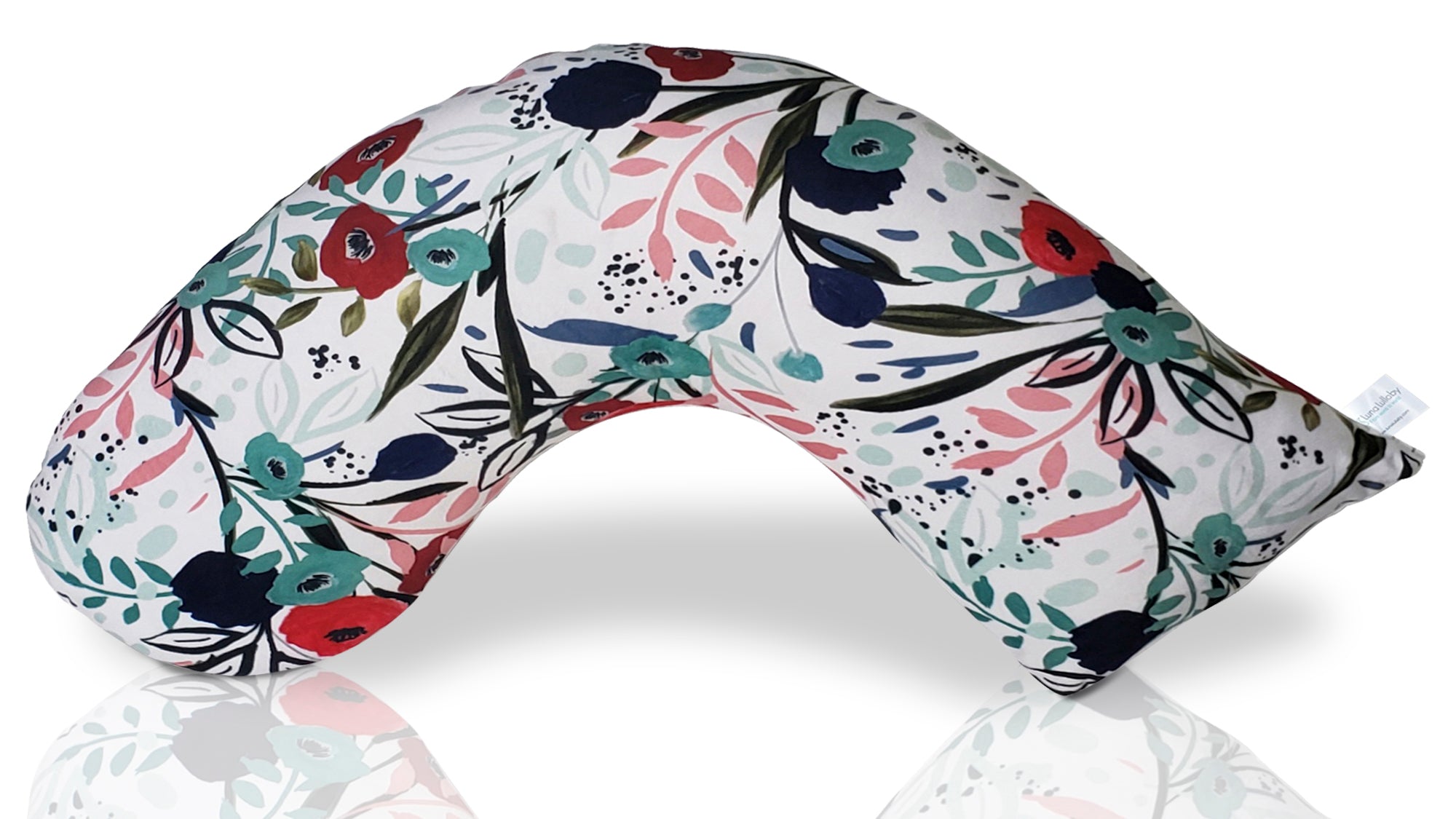
- V-shaped pillows like Luna Lullaby's design cradle the baby on both sides, which helps hold position without constant readjusting.
- Standard bed pillows offer no contour at all. They flatten under weight and require stacking to reach feeding height.
For a caregiver with a shorter torso or longer waist, a flat rectangle rarely sits at the right level, so you hunch forward to close the gap, where back and neck strain usually begins.

Firmness, Density, and Stability Compared
Firmness is the second major difference, and the one most parents underestimate. A bed pillow is intentionally soft for sleep; a nursing pillow needs enough structure to hold a baby's weight without collapsing.
What actually determines firmness
Three things decide whether a pillow holds its shape through a feed:
- Fill type. Polyester fiberfill is the most common fill in both. Loft, how tall the fill springs back after compression, separates firm from soft. Foam rebounds predictably; loose fiber can migrate and clump over time.
- Fill density. Two pillows can look identical and behave differently depending on how much fill is packed inside. A densely stuffed pillow resists compression; a loosely stuffed one flattens under weight.
- Seam and shell construction. A reinforced seam and tightly woven shell keep fill distributed evenly. A thin shell with a simple seam lets fill shift toward the edges, which is why bed pillows develop flat spots.
How the two compare in practice
| Feature | Nursing Pillow | Regular Bed Pillow |
|---|---|---|
| Shape | Contoured (C or V) | Flat rectangle |
| Fill behavior | Dense, resists compression | Soft, compresses under weight |
| Stability | Holds position through a feed | Shifts and flattens |
| Hands-free support | Yes, with proper fit | Rarely |
| Post-feeding use | Tummy time, sitting support | Sleep only |
A pillow that loses its shape mid-feed means you're supporting the baby's weight with your arms and shoulders instead, the reason many caregivers end up sore after a cluster-feeding stretch.
A quick at-home test
Press your palm into the center of any pillow and hold for ten seconds. A pillow built for feeding springs back to roughly its original height; a bed pillow leaves a dent that takes time to recover, the same dent your baby sinks into, which is why it keeps needing to be re-stacked.
Material and off-gassing considerations
Fill material matters beyond firmness. Some caregivers are sensitive to the smell of new foam or synthetic fill, or prefer to avoid synthetics around a newborn. If that's you, look for a removable, washable cover and a fill you're comfortable with, and air any new pillow out before first use. No pillow should be used as a sleep surface, regardless of fill type (aap.org).
Why an Ergonomic Breastfeeding Pillow Supports Better Positioning
An ergonomic breastfeeding pillow brings the baby to you rather than making you lean down to the baby, the single principle that separates it from a bed pillow.
When the baby sits at nipple level, your shoulders relax and your back stays neutral. When the baby sits too low, you round your spine and drop your chin, a common source of neck pain and shoulder tension during long feeds.
Luna Lullaby's V-shaped pillow was designed by a speech-language pathologist and feeding specialist specifically to position the baby at an optimal feeding level. The V-shape adapts to different body types and feeding positions, whether you're nursing, bottle feeding, or supporting twins.

That said, positioning is personal. What works for one caregiver's torso fit may not work for another's. If feeding remains painful or your baby struggles to latch, an IBCLC can assess your specific setup and offer individualized guidance.
How to Position Baby for Breastfeeding With Each Option
Positioning looks different depending on what you're using. With a dedicated pillow, the goal is a stable surface at the right height; with a bed pillow, you're working around a surface that keeps changing shape. Here's how to do both, including a stacking method for caregivers who want to skip the purchase.

Cradle Hold and Football Hold Setup
For the cradle hold, the baby lies across your front with their head in the crook of your elbow, body turned toward you, tummy to tummy. The pillow supports your forearm and brings the baby up so their nose aligns with your nipple.
For the football hold, the baby tucks under your arm along your side, feet pointing behind you. This position can be easier after a C-section because it keeps pressure off the incision. A firm pillow supports the baby's back and legs while your hand guides the head.
With a bed pillow, both positions usually require stacking and re-stacking as the pillow compresses. With a contoured pillow, the shape holds the position so your hands are free to guide the latch.
A budget-friendly stacking method for regular pillows
If you're not ready to buy a nursing pillow, you can approximate the height and angle with what you already own. The goal is a stable, slightly inclined surface at nipple level, not a tall, wobbly tower.
- Start with a firm base. A couch cushion or folded blanket on your lap gives you a flat, stable foundation. Soft, down-filled pillows alone won't hold the shape you need.
- Add a firm pillow on top. A denser bed pillow, the kind that springs back when you press it, goes on the base. This is the layer your baby will rest on.
- Use a rolled towel to create the angle. Roll a bath towel or receiving blanket into a firm cylinder and tuck it under the front edge of the top pillow. This lifts the baby slightly toward you and helps close the gap that causes you to hunch forward.
- Check the height before you latch. The baby's nose should sit roughly level with your nipple. If you're leaning down to reach them, add another folded layer underneath. If you're reaching up, remove one.
- Re-check every few minutes. Bed pillows compress as they warm up. A stack that felt right at the start may drop an inch or two by the ten-minute mark, so plan to adjust.
This method works, but it has real limits. A stack of loose pillows doesn't hold a contour, so it can't cradle the baby the way a V-shape does, and it won't stay put if you shift positions. It's a reasonable bridge, not a permanent setup.
Why a V-shape changes the positioning math
A V-shaped pillow like Luna Lullaby's lets the baby rest in the valley of the V, supported on both sides rather than balanced on a flat surface. That contour does two things a stack of bed pillows can't: it keeps the baby from rolling toward or away from you, and it holds the height steady as you shift. The design was created by a speech-language pathologist and feeding specialist to bring the baby to an optimal feeding level without the caregiver leaning forward.
That said, positioning is personal. What works for one caregiver's torso fit may not work for another's. If feeding remains painful or your baby struggles to latch, an IBCLC can assess your specific setup and offer individualized guidance.
Safety Considerations for Infant Feeding Support
Infant safety during feeding comes down to three things: a stable surface, an open airway, and constant supervision. No pillow replaces your attention.
- Keep the baby's chin off their chest so the airway stays open (the CDC).
- Never leave a baby unattended on a nursing pillow, bed pillow, or any soft surface.
- Avoid using pillows for sleep. They are feeding and supervised-positioning tools, not sleep surfaces.
- Check that the baby's head is supported and their body is aligned, not twisted.
For guidance on safe infant sleep and feeding practices, the American Academy of Pediatrics safe sleep recommendations is a reliable starting point. If your baby shows signs of reflux, breathing difficulty, or feeding distress, contact your pediatrician rather than adjusting positioning on your own.
Back Strain, Posture, and C-Section Recovery
Back strain during feeding usually traces back to one cause: the baby sits too low, so the caregiver leans forward to compensate. Over many daily sessions, that posture leads to neck pain and shoulder tension.
An ergonomic setup keeps your spine neutral and shoulders relaxed. For caregivers recovering from a C-section, the football hold paired with firm support can reduce pressure on the incision, and a pillow that holds its shape means less core engagement to keep the baby in place.
What to Look For in a Nursing Pillow
Choosing well comes down to fit, firmness, and how the pillow holds up over months of daily use. A pillow that fits your torso and stays firm will do more for your comfort than any feature list.
- Contour that matches your body. A V-shape or C-shape should wrap without gaping.
- Firmness that holds up. The pillow should support a baby's weight without flattening.
- Washable, breathable covers. Spit-up happens daily. A removable, machine-washable cover makes cleanup simple.
- Hypoallergenic fill. A practical choice for babies with sensitive skin.
- Versatility. Look for a pillow that works for breastfeeding, bottle feeding, and tummy time.
Luna Lullaby's nursing pillow checks these boxes: a V-shape designed for positioning, machine-washable covers, and a design trusted by lactation professionals. It's also made in the USA and has been used by families for more than 20 years. If you're looking for a portable option, the Luna Lullaby Travel Pillow offers the same V-shaped support in a lighter, travel-friendly size.
Beyond Feeding: Post-Breastfeeding Utility and Long-Term Value
A nursing pillow's usefulness doesn't end when feeding does, this is where a dedicated pillow earns its keep.
As your baby grows, a supportive pillow becomes a tummy time prop, a sitting-up aid, and a comfortable spot for supervised play. The Luna Lullaby V-Shaped Nursing Pillow is designed for this kind of extended use, which is why it stays in rotation long after the newborn stage.
A bed pillow, by contrast, goes back to the bed, meaning you're buying a feeding solution and a sleep solution separately rather than one item that does both jobs.
Conclusion
The choice between a nursing pillow and a regular bed pillow isn't really about cost. It's about whether your setup supports your posture and your baby's position for the hundreds of feeding sessions ahead.
A bed pillow can work in a pinch, but a dedicated pillow holds its shape, brings your baby to the right height, and keeps working for you long after feeding ends. Luna Lullaby has spent more than 20 years designing V-shaped nursing pillows that support comfortable positioning for breastfeeding and bottle feeding, with machine-washable covers, and American-made quality.
Get started with Luna Lullaby and give yourself and your baby the support that makes every feeding session easier.
Frequently Asked Questions
Do I actually need a nursing pillow, or can I just use bed pillows?
Regular bed pillows can work in a pinch, but they tend to shift and lose shape during a feeding session. A nursing pillow is designed to stay in place and keep your baby at a consistent height, which can reduce neck and shoulder tension for you. If you feed frequently or for long stretches, a dedicated nursing pillow often makes sessions more comfortable and predictable.
What are the ergonomic benefits of a V-shaped nursing pillow?
A V-shaped ergonomic breastfeeding pillow cradles your body and brings your baby up to nipple level, which can help reduce the need to hunch or lean forward. That positioning may ease back strain and shoulder tension during feeding. The shape also adapts to different body types and feeding positions, including cradle hold and football hold, so you are not fighting the pillow to get comfortable.
Can regular bed pillows provide adequate support for bottle feeding?
Bed pillows can support bottle feeding if you stack them carefully, but they often slide out of position. A nursing pillow holds its shape and keeps your baby at a steady angle, which can make bottle feeding easier on your arms and back. If you bottle feed often, a pillow designed for feeding support is worth trying.
Are there safety considerations when using pillows for infant feeding?
Always supervise your baby during feeding and never leave them unattended on a pillow. Pillows are not for infant sleep, and you should keep your baby's face clear and airway unobstructed. If you have concerns about latch, reflux, or breathing during feeds, talk with your pediatrician or an IBCLC for personalized guidance.